The Supplement Industry Has a Credibility Problem
Walk into any supplement store and you'll find hundreds of products making performance claims. Most of those claims rest on a handful of small studies, funded by the manufacturer, conducted over a few weeks. The research landscape for most supplements is thin at best and misleading at worst.
Creatine monohydrate is the exception. It has accumulated over three decades of independent, peer-reviewed research across thousands of subjects. Its mechanisms are understood. Its safety profile is established. Its efficacy is not a marketing position — it's a scientific consensus.
How Creatine Actually Works
During high-intensity exercise — a heavy squat, a sprint, the final reps of a set — your muscles demand ATP faster than your aerobic system can produce it. Phosphocreatine stored in muscle tissue steps in immediately, donating a phosphate group to spent ADP to regenerate ATP on the spot.
Supplementing with creatine monohydrate increases the concentration of phosphocreatine available in your muscles. More phosphocreatine means a larger buffer during peak effort — which translates to more reps completed, higher peak power output, and greater mechanical stimulus per training session. Over time, that additional stimulus compounds into measurable strength and lean mass gains.
This isn't a theoretical mechanism. It's been demonstrated repeatedly across strength athletes, endurance athletes, older adults, and untrained populations.
Why Monohydrate Specifically
The supplement market has produced creatine ethyl ester, creatine HCl, buffered creatine, and a range of other forms — most marketed as superior to monohydrate with minimal evidence to support that claim. Monohydrate is the form used in the overwhelming majority of research. It has the most data, the longest safety record, and the lowest cost per effective dose.
There is no peer-reviewed reason to pay more for a different form. Monohydrate works. The studies say so.
The Protocol Is Simple
3 to 5 grams daily. No loading phase required — loading accelerates saturation slightly but produces identical long-term results. No cycling — creatine does not downregulate endogenous production in a meaningful way. Consistency matters more than timing, though post-workout or with a carbohydrate source may marginally improve uptake.
That's it. One of the most researched compounds in sports science, and the protocol fits in a single sentence.
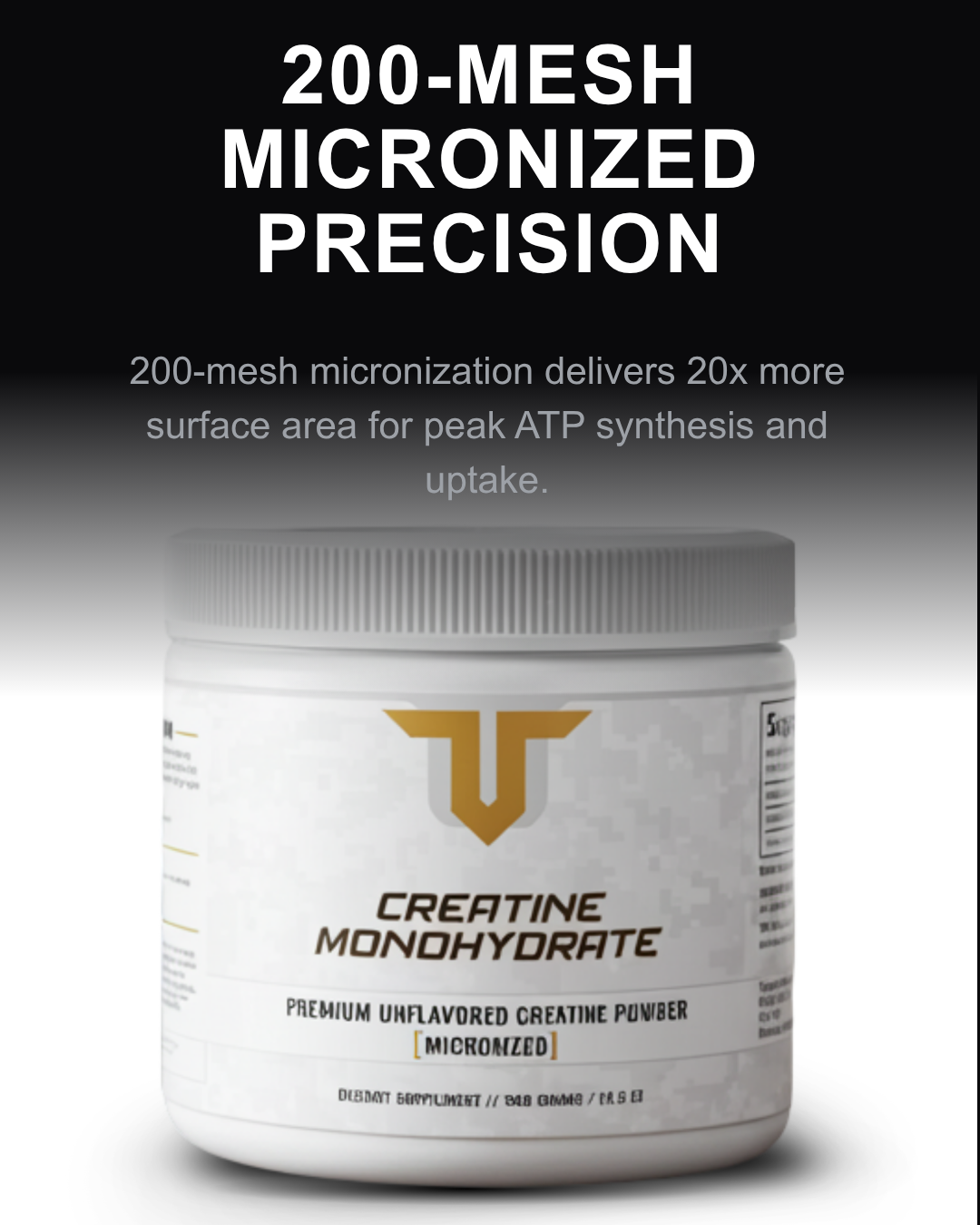
Troponin Creatine is plain monohydrate — no additives, no blends, no unnecessary complexity. The form that earned the evidence. Get yours here.